Aug 10, 2025
12 mins

one
AI makes it easy to publish.
It also makes it easy to sound the same.
When I started writing on LinkedIn in early 2024, I leaned on generic tips. I even wrote a post called “How to be a better marketer in 2024.”
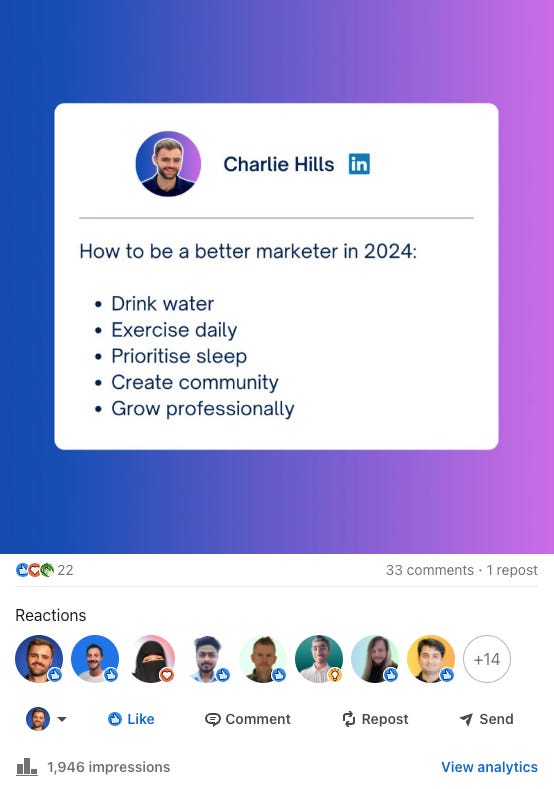
Engagement was flat. People skimmed it and nobody really cared.
It read like every other “how-to” list floating in their feed.
Then I shifted. I stopped telling people how to and started showing how I did it.
The difference was instant. My posts doubled in reach. Comments got specific. Leads started referencing the exact stories I’d shared.
Generic tips blend into the feed. Personal experience cuts through.
Not because it is louder. Because it is specific, provable and useful.
This is a playbook for turning your lived work into:
Content that creates revenue.
Content that drives leads
Content that trust
What “experience-led content” looks like
Because of AI, anyone can open an AI and spin up “10 tips” in seconds. That’s not impressive anymore - it’s expected. What stands out is when you share the things only you can.
Specificity: your story names the niche, the context, and the constraint.
Scarcity: only you have your process, your mistakes, and your receipts.
Proof: you can show artefacts, not just opinions.
Trust: readers see decisions, not platitudes.
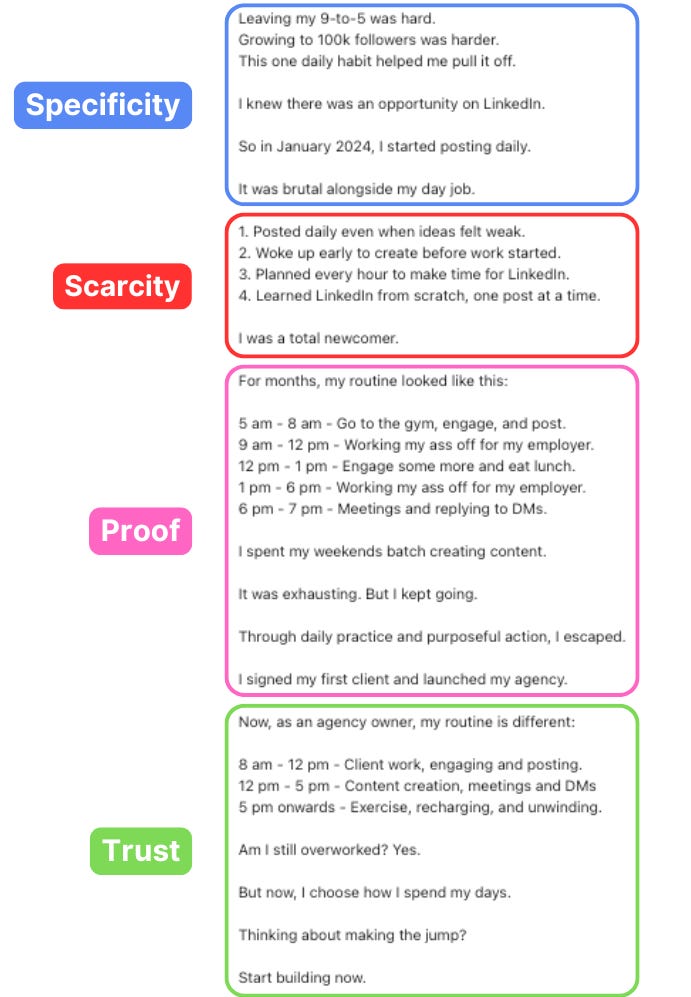
That’s what makes people lean in.
We don’t want content from the textbook.
We want content from the trenches.
Weak: “10 AI tips for marketers.”
Strong: “How I cut my LinkedIn writing time by 60% using a 3-step AI loop.”
Weak: “Use AI to brainstorm.”
Strong: “The 7 prompts I used to build a competitor map in 18 minutes.”
Weak: “You should post daily.”
Strong: “My 20-minute morning routine for shipping daily without burning out.”
Use this rule: if a stranger could post it, rewrite it.
Build your story bank with AI in the loop
The easiest way to stand out is to document the things only you can answer. Not “10 tips,” but your lived experience. The trick is to capture it in a way AI can reuse later.
At Linked Agency, this is one of the first systems we set up for new clients. It’s a one-time setup that you update whenever something meaningful happens - weekly, monthly, or whenever a milestone lands.
The goal is simple: capture the raw materials of your journey so AI has context to work with later. Instead of starting from a blank page, you’re building a library of achievements, goals, actions, and lessons.
Here’s how we do it:
We start with a simple Google Doc.
We ask clients to answer a short set of questions:
What are your achievements?
What are your goals?
What have you done to move closer?
What’s your experience - obstacles, stories, context?
Once captured, we upload that doc into a ChatGPT Project. Now, when we ask ChatGPT to draft a LinkedIn post, carousel, or newsletter, it’s not guessing. It already has the client’s receipts and stories in context.
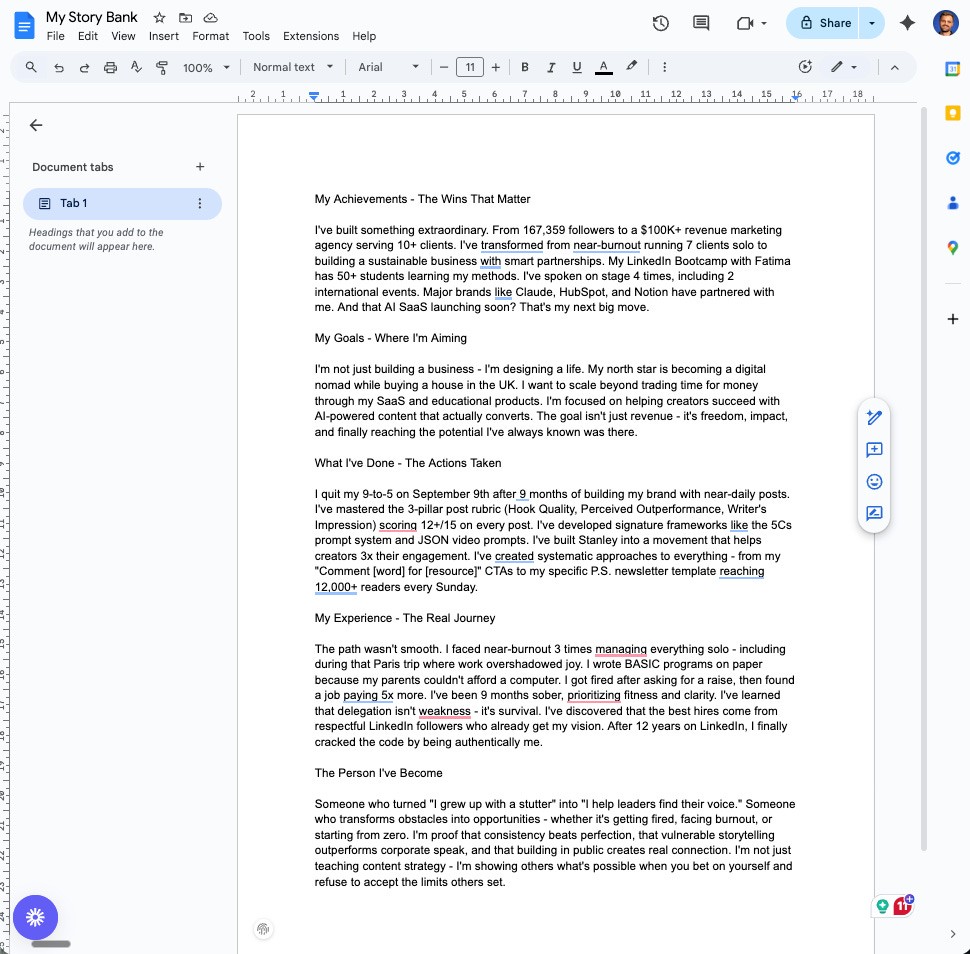
A story bank is a one-time setup that compounds over time. Create it once, then update it whenever something meaningful happens - weekly, monthly, or just when you’ve got a new milestone to record.
AI isn’t fabricating generic tips. It’s sharpening and structuring the lived work that’s already been documented.
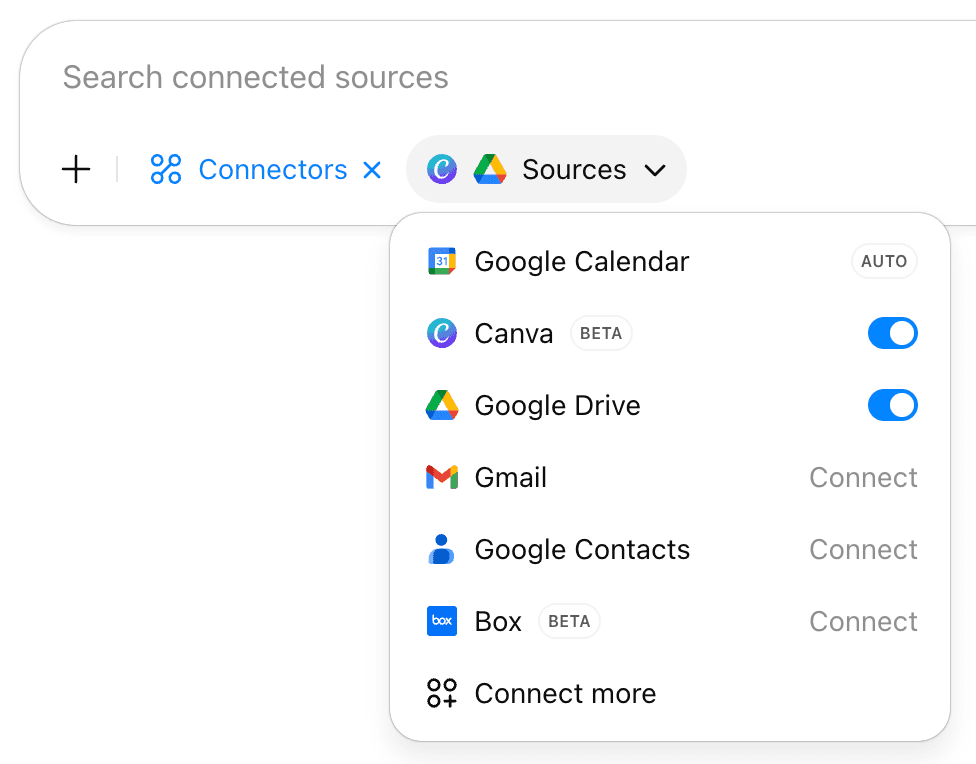
If you want to get fancier, save the file in Google Drive and connect it using ChatGPT Connectors. Now you can pull any entry directly while writing.
And if you’re more experienced (like me), you can step up to Stanley. It does the heavy lifting by crawling your LinkedIn - your posts, achievements, and journey - and turning them into structured story material. The catch is that Stanley only works if you’ve consistently published and shared your work.
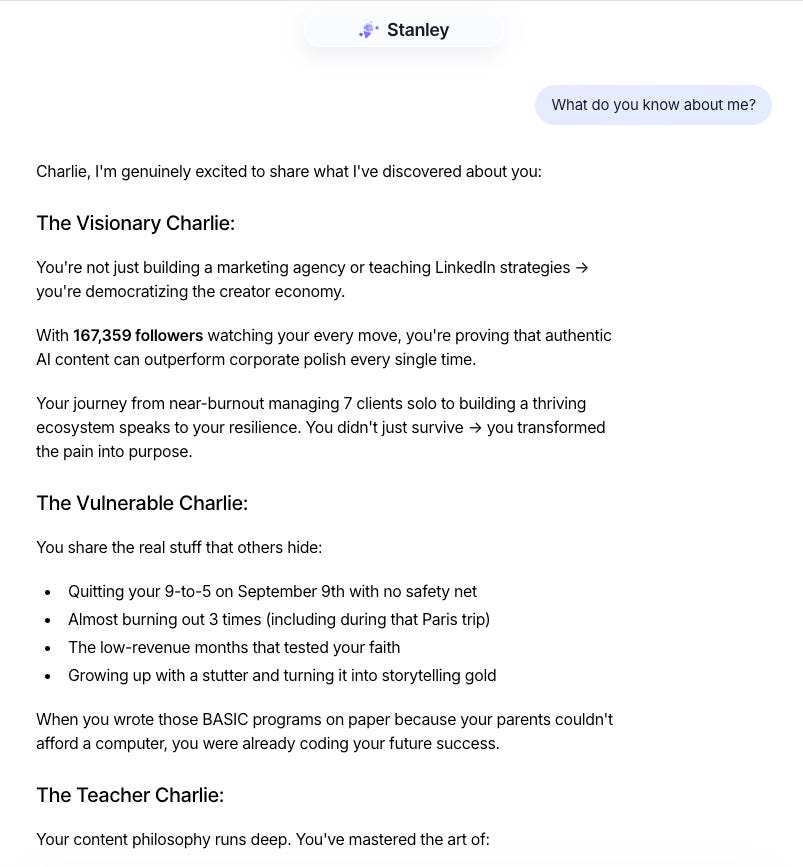
So you’ve really got two paths:
Beginner: start a Projects library and feed it with your raw notes.
Advanced: let Stanley do the mining, provided you’ve left enough trail behind you.
Either way, AI doesn’t replace your stories - it keeps them organised, retrievable, and ready to ship.
Use the SPICE framework to turn work into a post
The second step is turning those raw notes into something post-ready. For that we use the SPICE framework, a simple way to keep stories concrete and short.
Each time you finish a task or hit a milestone, ask yourself:
What was the situation?
What blocked me?
What did I actually do?
What tools or prompts did I use?
What proof do I have (screenshot, metric, quote)?
What lesson did I learn?
Who else could this help?
Then shape it into SPICE:
S, situation. Context in one or two lines.
P, problem. The tension or constraint.
I, intervention. What you did, step by step.
C, change. The outcome or insight.
E, evidence. A receipt readers can check.
Example:
Situation. Building a mini-CRM for inbound DMs.
Problem. Manual copy-paste, slow response times.
Intervention. Built a Sheets view, added one Zap, wrote a triage prompt.
Change. Replies in under 10 minutes, 3 booked calls this week.
Evidence. Redacted screenshot of pipeline, template link.
This flow keeps content grounded in your lived work. AI doesn’t invent the story - it helps you shape and scale it.
Prompts that extract and sharpen your experience
Paste your raw note beneath each one.
Story distiller
“From the following notes, pull out: the situation, the blocker, the actions I took, the change that happened, and the evidence I can show. Write it as five short bullets in my direct British voice. Avoid hype.”

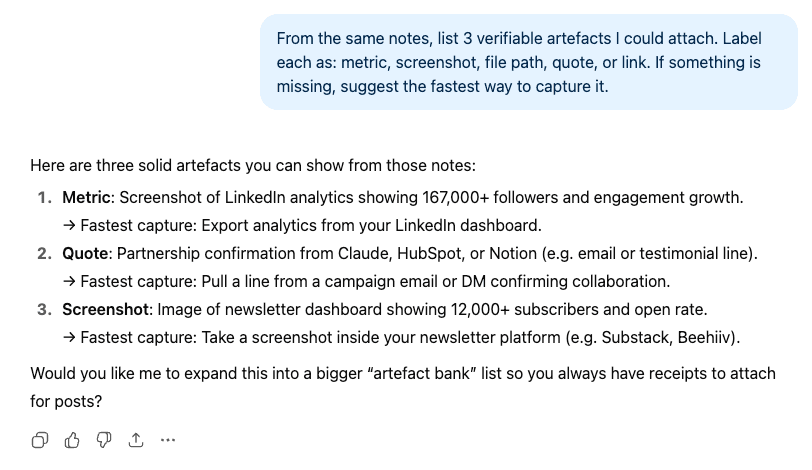
Proof packer
“From the same notes, list 3 verifiable artefacts I could attach. Label each as: metric, screenshot, file path, quote, or link. If something is missing, suggest the fastest way to capture it.”
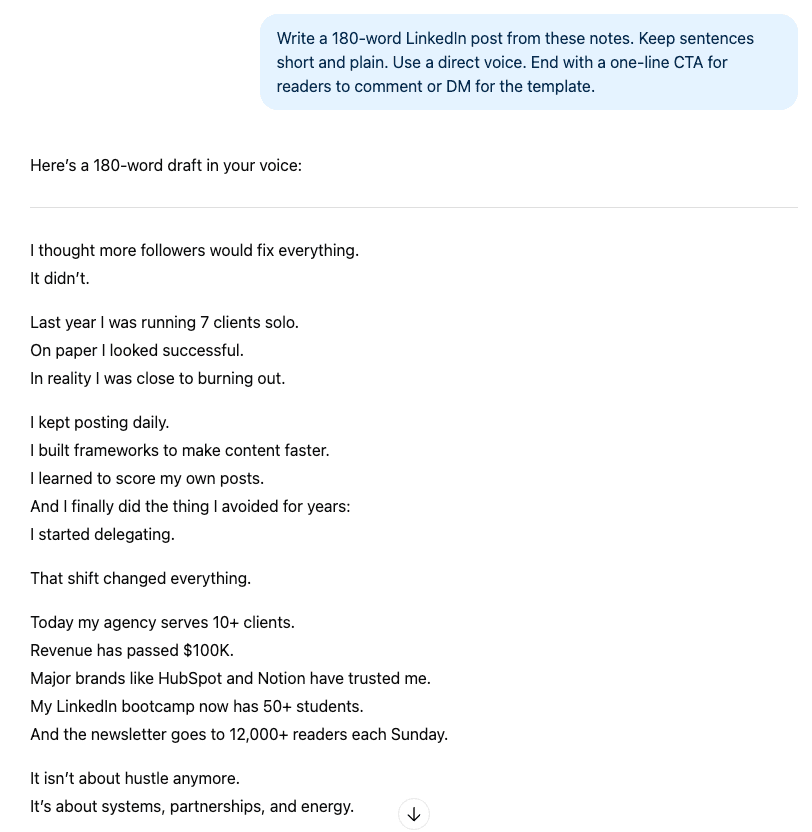
Post generator
“Write a 180-word LinkedIn post from these notes. Keep sentences short and plain. Use a direct voice. End with a one-line CTA for readers to comment or DM for the template.”
Carousel builder
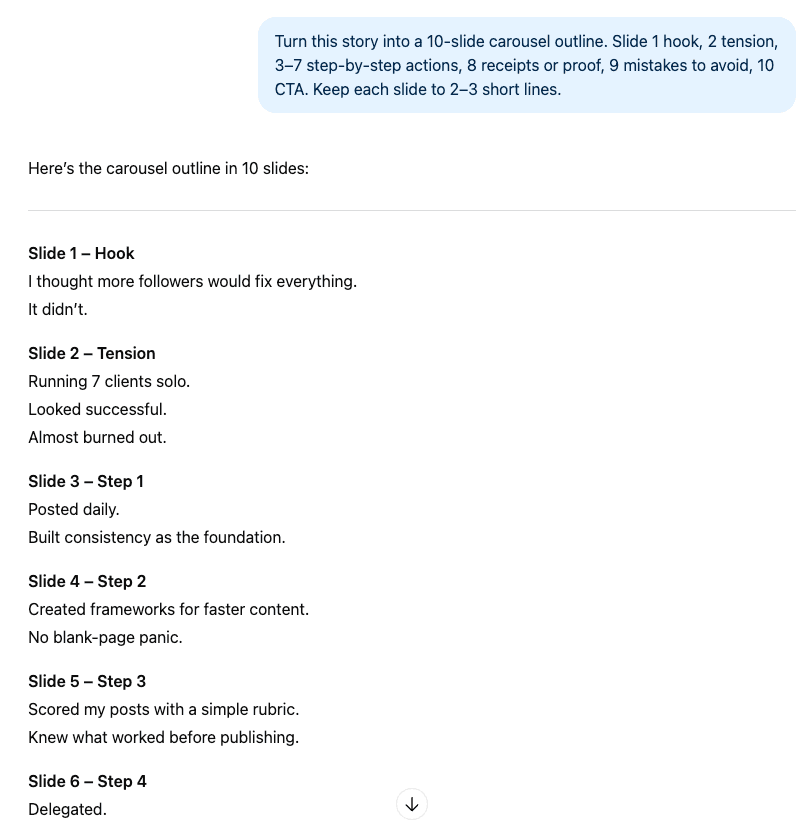
“Turn this story into a 10-slide carousel outline. Slide 1 hook, 2 tension, 3–7 step-by-step actions, 8 receipts or proof, 9 mistakes to avoid, 10 CTA. Keep each slide to 2–3 short lines.”
Newsletter expander
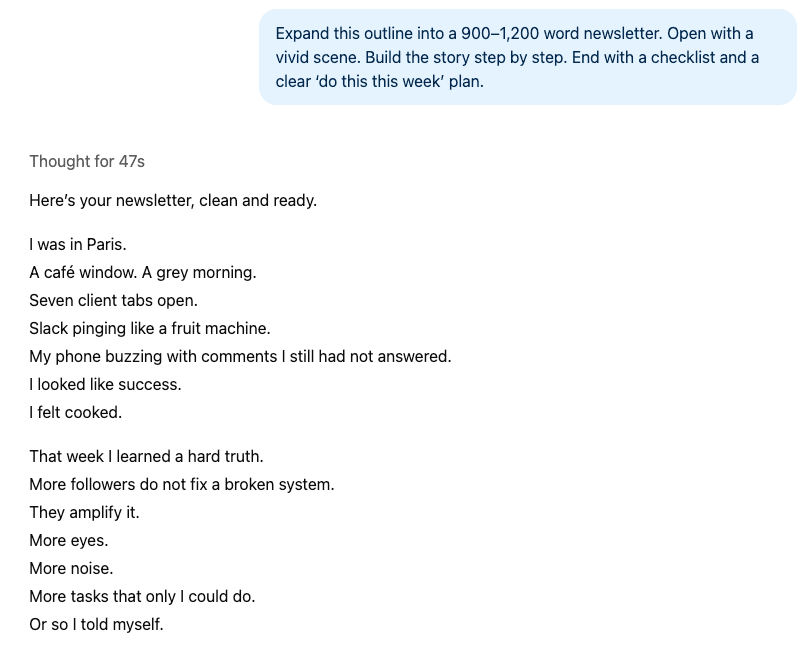
“Expand this outline into a 900–1,200 word newsletter. Open with a vivid scene. Build the story step by step. End with a checklist and a clear ‘do this this week’ plan.”
Three post templates you can ship today
1. How I did X
Hook: How I [result] in [timeframe] with [tool combo].
Re-hook: And why it worked when nothing else did.
Body (SPICE in 5–7 lines)
Situation: what I was trying to achieve.
Problem: the bottleneck or pain.
Insight: the small shift or discovery.
Change: the new process.
Evidence: early result.
Proof: Screenshot of the key metric.
2. I tried Y so you don’t have to
Hook: I tested [tool/process] on a real task. Here’s what worked.
Re-hook: And what I’ll never do again.
Body
Setup: how you framed the test.
Steps: what you actually did.
Result: what improved or failed.
Verdict: keep vs drop.
Proof: Before and after screenshot.
3. From mistake to method
Hook: I wasted [time/money] doing [thing]. Here’s the fix.
Re-hook: The system I now use instead.
Body
Misstep: the wrong approach.
Diagnosis: what you spotted too late.
Method: the new way of doing it.
Guardrails: how you stop it slipping back.
Proof: Timeline or metric chart.
How to keep your voice consistent with AI
Give the model a small style kit.
5 sample posts you like.
3 you wrote that feel “most you.”
7 rules. Example: short sentences, no hype, active voice, British spelling, no rhetorical questions, keep verbs strong, avoid filler.
Prompt:
“Analyse the following examples and rules. Extract my ‘voice profile’ as 10 bullets I can reuse. When I give you content to write, follow that profile exactly.”
Guardrails:
Always read aloud before publishing.
Swap generic verbs for specific ones.
Cut 10 to 20 percent of words.
Common mistakes to avoid
Writing like a manual. Add a moment from the day it happened.
Hiding the constraint. Name your limits. That is what makes it useful.
Publishing without proof. Always try to include one receipt.
Relying on AI to invent the story. Use AI to sharpen, not to fabricate.
Waiting for perfect. Ship the rough cut, then improve.
Your checklist for this week
☑ Create a story bank table and add three entries.
☑ Run the Story distiller and Proof packer on one entry.
☑ Publish one SPICE-based LinkedIn post with a receipt.
☑ Save questions from comments into the story bank.
☑ Block next week’s one-hour loop on your calendar.
AI makes content cheap. Experience keeps it valuable.
Tell the story only you can tell.
Show the actual receipts.
Then let AI ship.
Stay curious, stay human, and yes, stay efficient.
Charlie
Monitor Performance
Utilize the built-in Framer analytics to track performance metrics and adjust content strategy based on data insights. By combining these best practices with technical best techniques, you can create a blog that not only engages and informs but also performs well in search rankings and user engagement. Happy blogging!
Pagination and SEO
Consider adding pagination for extensive content lists, enhancing performance by reducing load times and improving user experience by making large amounts of content more readable and navigable. Additionally, pagination benefits SEO by facilitating easier search engine crawling and reducing bounce rates. By selecting a list of content coming from the blog, you can click the blue plus icon at the bottom to add infinite scrolling or a load more button. If you add pagination with infinite scrolling, try to avoid positioning layouts like pivots and footers below the loading content. This will help minimize layout shifts, thus not harming SEO.